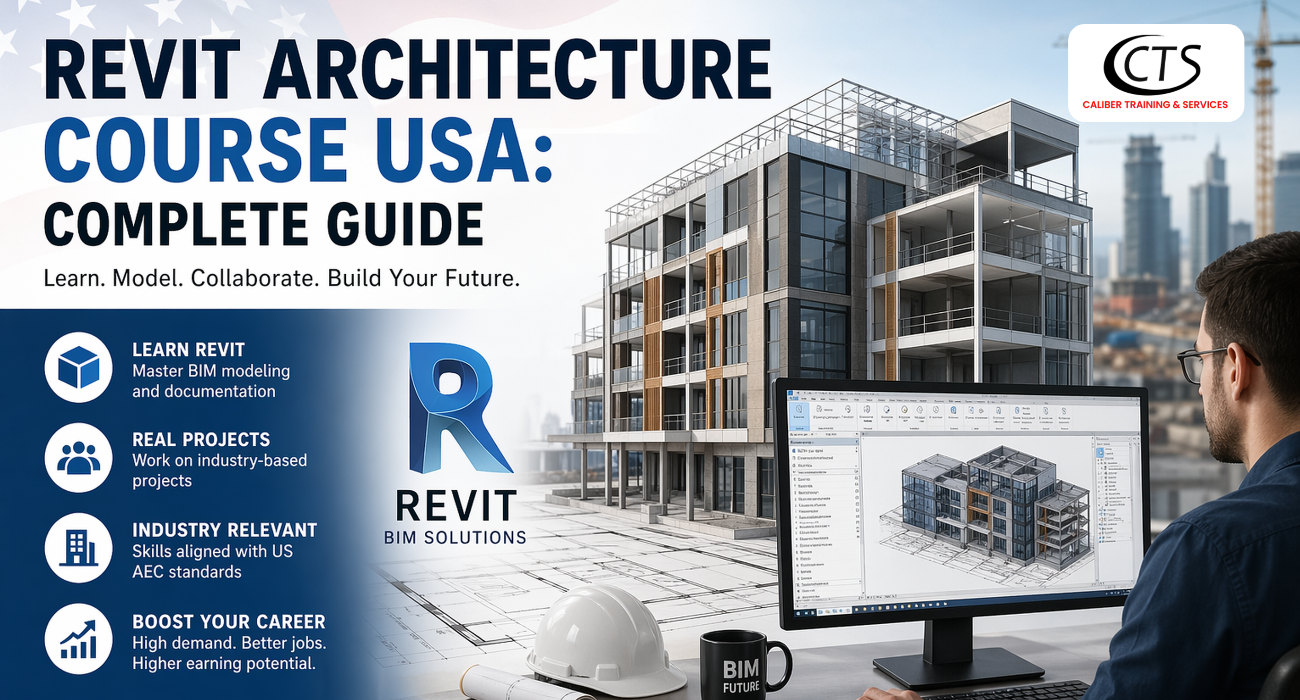
Revit Architecture Course USA: Complete Guide
You are already familiar with the fact that Revit is no longer optional in the US, whether you work in architecture, engineering, or construction. The majority of the firms will require you to know it. And otherwise, you are missing out on jobs.
This guide will explain all you need to know when choosing the right Revit Architecture course USA – what to consider, what you will actually learn, how online training works, and what follows.
What Is Revit and Why Does It Matter Now?
The Building Information Modeling (BIM) software of Autodesk is known as Revit. It allows architects, structural engineers, and MEP professionals to create buildings in 3D and attach real data to each element, i.e., walls, doors, floors, and systems.
This is what distinguishes it from AutoCAD. In AutoCAD, you draw lines. In Revit, a model is created. Adjust the height of a wall, and all the floor plans, sections, and schedules update automatically. That’s parametric modeling.
The US construction industry is now greatly dependent on BIM. BIM delivery is needed in federal projects, commercial development projects, and large-scale infrastructure work. In case you are an architect in the US, and you do not know how to use Revit, that is an issue, and a Revit Architecture course USA will solve the problem in the shortest time possible.
Who is to attend a Revit Architecture Course?
You don’t need to be an architect to benefit from Revit training. The most common enrollees are:
- Students of architecture who complete their degrees.
- New graduates to the workforce.
- CAD specialists who upgrade out of AutoCAD.
- Civil and structural engineers are developing their capabilities.
- Managers who will read and work with BIM models in construction.
- Interior designers of large commercial projects.
When you fall into either of these categories, a Revit architecture online course will be worth your time.
What You Learn in a Good Revit Course
Revit training online will not simply show you the operation of the buttons. It shows you how Revit thinks – that’s another thing.
BIM Concepts core First
You must know what BIM is before you are able to touch any tools. This is the beginning of a good Revit Architecture course USA. You will understand what BIM and CAD are, the flow of information through a model, and the importance of cross-disciplinary coordination.
Parametric Modeling
Here is the basis. You will be taught how to make walls, floors, roofs, doors, and windows as parametric elements. You will learn about families—what Revit calls the types of components—and how to edit them.
Learning constraints also imply parametric modeling. The system will remember that when you program a wall to be a particular height. Adjust the wall and change the floor level. It is an intelligent design of that kind that makes Revit strong.
Documentation and Sheets
Revit produces documentation out of the model. The same source provides floor plans, elevations, sections, and schedules. You will spend a lot of time on these topics in Revit training online, as the majority of architectural work is found in documentation.
You will be taught to make sheet sets, title blocks, annotations, and dimensioning. You will also get to know how to control view templates to ensure that your drawings appear uniform.
Collaboration and Worksharing
In actual projects, there are several individuals using the same Revit model. That’s called worksharing. This will be taught in a Revit architecture online course that is worth taking. You will get to know central models, local files, worksets, and how to sync changes without breaking things.
Site and Massing Tools
This is omitted in many courses. Don’t skip it. Revit contains conceptual massing and site design tools that can be useful in initial design efforts. Knowledge of how to collaborate with topography and site context will provide an advantage.
Energy and Sustainability Analysis
Revit has links with energy analysis. An excellent course will present you with this. The US demands more and more that architects have an awareness of energy performance, and Revit allows such an analysis to be a part of the modeling, rather than a distinct step.
Revit Architecture Online Course: What to Look For
The US market has dozens of Revit training online options. How to sort out the good ones and the rest.
Real Project-Based Learning
Theory is fine. But you would prefer a course in which you actually construct something residential, a commercial building, or a multi-story. The Revit workflow can only be familiarized with through project-based learning.
Up-to-Date Content
Revit is an annual update. In 2025, a course based on Revit 2020 material will be outdated. Ensure that the course you choose includes the latest version and discusses what is included in the course, such as the updated sheet management tools, the enhanced collaboration in the cloud, and the generative design capabilities that Autodesk has been introducing.
Instructor Experience
The instructor must have actual project experience—not simply teaching experience. A person who has applied Revit to real-life construction projects will teach you more than someone who is just aware of the academic part.
Online vs. In-Person Revit Training
Both work. The choice depends on your situation
In-person training provides you with close contact with an instructor. You are able to ask questions online and receive instant feedback. This is your choice in case you are a structured and face-to-face learner.
Revit architecture online course provide you with options. You can study at your own pace, go over areas of confusion, and can even schedule training within your working time. There are also quality online programs that incorporate live Q&A sessions thus you are not entirely alone.
Revit training online is typically more suitable for working professionals. You don’t need to take time off. You don’t need to commute. And numerous online courses are cheaper than their face-to-face counterparts.
Caliber Training Services offers structured, instructor-led training with project exposure, should you be in need. They provide practical training, both basic and advanced, and the trainers have work experience in the industry.
Revit and the US Job Market
There is a high demand for Revit skills in US. Here’s why
BIM was required by the US government for federally funded construction works several years ago. That compelled companies of all magnitudes to implement Revit. Now it’s standard. It is not only used by large firms but also by mid-size and small firms.
In the US, the wages of BIM-skilled architects and designers are more expensive than those of unskilled ones. A Revit Architecture course USA is in itself a direct investment in your earning capacity.
Some of the most frequently used job titles that need Revit are:
- BIM Coordinator
- Architectural Designer
- Revit Technician
- Project Architect
- Construction Documentation Specialist
- MEP Designer
Conclusion
Revit is not a nice-to-have, unless you are serious about working in the US AEC industry. It’s a requirement. The upside of it is that with a properly designed Revit architecture online course you can be there without investing an enormous amount of time.
Choose a course that has real projects, current content, and an instructor who has worked on real buildings. Complete the practice hours. And take your time- Revit compensates those who take time to learn how to use it.
Caliber Training Services can be considered to provide structured, practical Revit training online with industry experience support. They provide real-world training programs that are based on the real-world application of these tools.
The time and money you spend in a Revit Architecture course USA will benefit you throughout your career.

You may also like
Top Career Opportunities After Learning Revit MEP