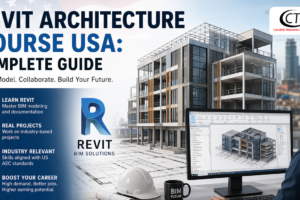

Revit Architecture & MEP Online Training: Everything You Need to Know
In the constantly dynamic world of Architecture, Engineering, and Construction (AEC) industry, being on the cutting edge is not only beneficial but also a necessity. Building Information Modeling (BIM) has transformed the way projects are designed, built, and managed, and in the middle of this change is Autodesk Revit. In the architecture and MEP (Mechanical, Electrical, and Plumbing) Building Sciences, mastering Revit has become no longer a subtlety but a prerequisite among professionals and future students of the field. Caliber Training and Services leads in offering some of the best Revit Architecture online and Revit MEP online training, which enables individuals to master this dynamic world. Everything you need to know about our special online training programs will be discussed in this blog.
The demand for skilled Revit professionals is higher than ever before. With the rise in complexity of projects, the necessity to design efficiently, collaboratively and sustainably, BIM and Revit are continuously being adopted across the world. This influx has resulted in a tremendous skills shortage in the trade; certified Revit professionals are now in high demand. We have created our Revit online training with the view to close this gap and providing a flexible and effective learning journey to both beginners and experienced professionals. You need a complete Revit MEP course or expertise in architectural modeling; our online platform can give you the means to accomplish it.
How Revit Changing AEC Industry?
It is important to know the reason why Revit is the industry standard before delving into the details of our training programs. In contrast to the 2D CAD software, Revit is an effective 3D modeling tool and allows a collaborative and data-intensive workflow.
Revit Architecture:
Revit enables architects to develop smart 3D models, which hold much information. Elements such as walls, doors, and windows, as well as roofs, are parametric objects that can have their data. This implies that whatever changes are done in a single view are automatically reflected in the rest of the views, such as floor plans, elevations, sections, and schedules.
This single source of truth reduces the chances of mistakes, improves coordination, and greatly improves the design process. Through our Revit Architecture online training, we look at utilizing such abilities to produce exquisite and effective architectural designs.
Revit MEP Engineering:
In the case of Mechanical, Electrical, and Plumbing engineers, Revit offers a specific category of tools to design and document the complex systems of buildings. The capability to represent MEP systems in 3D with the architectural and structural models enables the detection and rectification of clashes early on, before they result in costly issues in construction.
Revit MEP training provides engineers with the skills that will enable them to design, analyze, and document these systems with unmatched accuracy and efficiency. Our Revit MEP classes encompass all the elements of MEP design in Revit, including HVAC ducting and piping systems, electrical conduits, and panel schedules.
Why Choose Revit Online Training?

Flexibility is important in the contemporary fast world. Revit online training programs are tailored to meet your schedule so that you can study at your own pace without sacrificing the quality of the education. These are just a few of the major benefits of attending Caliber Training and Services to get educated in Revit:
Expert-Led Training: We are the creators and instructors of our courses, whose background in Revit Architecture and MEP is vast and founded on real-world experience.
Broad-Based Curriculum: We have organized and detailed a curriculum that encompasses all the basics and the advanced subjects.
Hands-On Learning: We do training in a project-based way, so you will be working on real-world problems that will provide you with practical, hands-on experience.
Flexible Learning: Study the contents of your course at any time, anywhere, so long as you have internet access.
Interactive Support: Have your concerns clarified via our special support platforms, such as forums and a live question-and-answer basis.
If you are looking for Revit courses near you, consider our online service, which offers professional training from the comfort of your own home.
Deep Dive into Our Revit Architecture Online Training
From an amateur to an expert, the Revit Architecture online course is structured to bring you to the level of a skilled Revit user who can create intricate and professional architectural models.
Course Curriculum: What You Will Learn.

Introduction of BIM and Revit: Learn the fundamentals of Building Information Modeling and the Revit interface.
Basic drawing and editing: Learn how to use the most basic tools to design and edit architectural components.
Introduction to Core Architectural Elements: Learn how to model walls, doors, windows, floors, roofs, and ceilings.
Advanced modeling techniques: Learn about complex types of walls, curtain walls, stairs, and railings.
Writing Families: Learn to write your own parametric families and how to make your own custom components.
Documentation and Annotation: Produce floor plans, elevations, sections, as well as detail drawings. Get to know how to add dimensions, text, and tags.
Schedules and Quantity Takeoffs: Prepare correct schedules of the doors, windows, and other items, and carry out quantity takeoffs to estimate the costs.
Visualization and Rendering: Author high-quality 3D visualization, walk-thrus, as well as photorealistic images.
Working in a Team and Sharing: Learn how to collaborate on the same project with multiple team members.
At the conclusion of this training, you will be in a good position to take any architectural project to completion using Revit, starting with the initial design and going all the way through the building documentation.
Learning MEP Systems: Our Revit MEP Course.
The Revit MEP course is intensive and encompasses the three major disciplines of Mechanical, Electrical, and Plumbing engineering. This is the specialized Revit MEP training that suits the engineers, designers, and drafters who want to revise their skills in building systems design.
Mechanical (HVAC) Design
The HVAC module of our Revit MEP classes is concerned with the design and analysis of heating, ventilation, and air conditioning systems.
HVAC Systems Design: Study how to locate air terminals and mechanical equipment and develop sensible HVAC systems.
Ductwork Modeling: Learn how to make ductwork and duct fittings, as well as how to make correct connections.
Duct Sizing and Analysis: Do the calculations of duct sizing and analyze the performance of your HVAC systems.
Developing Mechanical Schedules: Make mechanical equipment and ductwork schedules.
Electrical Design
The electrical module gives a detailed insight into how to design and document electrical systems in Revit.
Electrical System Installation: How to set up electrical settings, install lighting fixtures, receptacles, and other electrical equipment.
Making Circuits and Wiring: Learn to make electrical circuits and wiring for your model.
Panel Schedules: Build and customize panel schedules and record your electrical design.
Cable Tray and Conduit Modeling: This course teaches how to model cable trays and conduits so that you can route your electrical systems.
Plumbing and Piping Design
The plumbing module deals with the design of plumbing and piping systems of sanitary and domestic water systems.
Piping System Design: Study how to design and alter piping systems, add fittings, and join plumbing fixtures.
Piping Slopes and Calculations: Learn to use slope on piping of sanitary systems and flow and pressure calculations.
Developing Plumbing Schedules: Develop plumbing fixtures and piping schedules.
Fire Protection Systems: Learn about the modeling of fire protection systems, such as sprinklers and piping.
Caliber Training & Services provides you with a holistic knowledge of the three disciplines in our comprehensive Revit MEP training so that you become a valuable addition to any project team.
The Future of Revit and the Architecture and Construction industry
The AEC market has been at the edge of a revolution in technology, and Revit is at its heart. Technological innovations that have been combined with BIM processes will form the future of building design and construction.
Generative Design: The generative design tools of Revit enable users to quickly investigate various design alternatives according to predefined design requirements and constraints. This artificial intelligence solution will transform the preliminary phases of design.
Digital Twins: The information-intensive models developed in Revit are the basis of developing digital twins—virtual equivalents of real buildings. Facility management, performance monitoring, and predictive maintenance are the applications of digital twins.
Cloud Collaboration: The move by cloud-based collaboration tools such as Autodesk Construction Cloud is causing teams to collaborate in real time irrespective of where they are located.
Sustainability and Analysis: The integrated analysis tools in Revit allow architects and engineers to conduct energy analysis, lighting analysis, and other simulations to create more sustainable and energy-efficient buildings.
When you invest in Revit online training, you are not only learning a software, you are also getting ready to face the future of the AEC industry.
Career Opportunity of Revit Professionals
The Revit professionals are in high demand all over the world. A certificate in Revit architecture online or a Revit MEP course may provide a broad career opportunity, such as:
BIM Modeler/Technician: Prepare and managed 3D models of architectural systems and MEP systems.
BIM Coordinator: Coordinate different discipline models to locate and eliminate clashes.
BIM Manager: Management and control of BIM standards and workflows on projects.
Architectural Designer: Learn how to use Revit to design buildings that are both innovative and efficient.
MEP Engineer: Design and analyze more complicated building systems with Revit MEP.
Construction Manager: Make use of BIM models in construction planning, scheduling, and coordination.
The knowledge acquired during our Revit online classes will help you become one of the most competitive candidates in the job market and start your own successful and valuable working career.
Conclusion
To sum up, proficient work with Revit is no longer an optional skill of an architecture and MEP professional but a necessity. Caliber Training and Services, developer of the comprehensive Revit Architecture online and Revit MEP training, enables a flexible, effective, and industry-appropriate route to mastering this potent software.
When you sign up for our Revit MEP courses or architectural programs, you are investing in your future and putting yourself in a place where you can be successful in the dynamic and exciting field of Building Information Modeling. It is not only necessary to maintain pace with the industry but also to be on top of the pack with Caliber Training and Services.
Related Blog – Revit Architecture vs. Revit MEP: Understanding the Key Differences

You may also like
Top Career Opportunities After Learning Revit MEP
Revit vs AutoCAD: Which is Better for Architects?