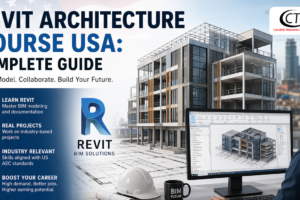

Top Skills You Will Learn in a Revit Architecture Course Online – Complete Overview
To future architects, interior designers, and civil engineers, learning how to use Revit is not an option anymore but a requirement for achieving the best results in their careers. Revit is not merely a drawing program; it is an elaborate database system that stores data regarding a building project from the concept up to the building’s construction. This is why a Revit Architecture online training is necessary in a complete manner. It can be used to fill the gap between the theory of design information and the skills required to perform the project in actual conditions.
Here, we will discuss our best skills that we will learn in the Revit architecture online course. We shall examine closely the technical aspects of the BIM, the individual application you will master, and its application in the job market. If you want to take a Revit Architecture course USA, or are looking for an international course, the first step to professional mastery is knowing about this curriculum.
Understanding of the BIM Methodology ( Building information modeling ).
The concept of BIM is the first skill you acquire before actually drawing a single wall, which is in a Revit architecture online course. BIM also employs smart objects, in contrast to CAD, which uses lines and arcs as the main representation of geometry.
Moving from Lines to Objects
A wall in AutoCAD is made of only two parallel lines. In Revit, a wall is a parametric object that has certain properties: height, thickness, material layers (brick, insulation, drywall), and thermal resistance, as well as cost information. You will have to learn to think in terms of families and instances and not layers and blocks. Such a change of thought is essential, as you can create a virtual prototype of the building.
Bidirectional Associativity
Your strongest concept you will learn is the concept of bidirectional associativity. You will find that a change anywhere means you change everywhere. When you drag a window on the floor plan, it will move on the elevation, section, and 3D view too. Removing a door from a schedule causes it to be removed in the model. Learning about the management of such interdependencies is a core competency that can save hundreds of hours of manual coordination.
Top Skills You Will Learn in a Revit Architecture Course Online
A properly laid out Revit Architecture online training teaches you numerous skills that would equip you to work with real projects in the industry. The most important of them are listed below.
The fundamentals of Building Information Modeling (BIM) are typically used in a Revit architecture online course. You will learn:
- What is BIM?
- CAD vs BIM Difference.
- The significance of BIM in the construction industry.
- The integration of information within a BIM model.
- Advantages of BIM in building, engineering, and architecture.
It is based on this that you come to appreciate why Revit does not act like AutoCAD.
Finding Your Way around the Revit Interface
You will learn how to:
- Use the ribbon interface
- Access the properties palette
- Use the project browser
- Manage views and visibility
- Know levels, grids, and fundamental settings of a project.
This helps you to gain confidence to work on the software alone.
- Designing 3D Architecture modelling
3D architectural modeling is one of the main skills in a Revit Architecture course USA. Revit is commonly associated with intelligent parametric components that are described as updating themselves automatically as they are being edited.
Creating Levels and Grids:
You will know how to make the levels of the floors and grids of structural alignment. This is the foundation of any building model.
The Modeling of Walls, Doors, and Windows:
Revit allows you to create:
- Architectural walls
- Curtain walls
- Compound walls
- Parametric doors & windows
In Revit, such elements are intelligent, that is, any modification found in one of the drawings is automatically updated in others.
Floors, Roofs, and Ceilings
You will learn how to:
- Create floor slabs
- Model flats, sloped, and complicated roofs.
- Add interior layout ceilings.
Revit is also used to create structural layers, material assignments, and thickness variations.
Construction of Stairs and Railings
Stair modeling may be complicated, and a Revit Architecture online course teaches you how to master:
- Straight stairs
- Curved stairs
- Multi-storey stairs
- Railings and balusters
In this case, these skills come in handy, particularly in major multi-level projects.
-
Establishing Detailed Architectural Designs
Once you have mastered the basics, you will begin to learn advanced architectural modeling.
Creating Rooms and Areas
You will learn to:
- Label rooms with attributes and properties.
- Automatic calculation of areas.
- Generate area schedules
This plays an important role in planning as well as the design of a commercial building.
Production of Building Components and Family
Revit possesses the concept of families: intelligent components such as equipment, fixtures, and furniture.
In the course, you will get to know:
- How to load families
- How to edit families
- The way of making new custom families.
- Variables Parametric family generating methods.
It is considered to be one of the best skills that you acquire in a course of Revit Architecture USA or any other Revit Architecture online training.
Interior Design Elements
You will learn to add:
- Furniture
- Lighting fixtures
- Plumbing fixtures
- Plans of the kitchen and bathrooms.
- Furnishings
This assists in outlining interior designs with precise details.
The Strategic Advantage of Online Learning
There are some unique benefits of doing a Revit architecture online course as compared to a classroom environment. Being able to take breaks, rewind backwards, and replay more complicated modeling processes is priceless. Acquisition of Revit is a linear process, and in the case of a tutorial on creating a family, failure to follow one step could ruin the whole model. The internet can also help you learn at your own pace, making sure that you have the skills of the different concepts before proceeding to the next.
Although it is possible to find numerous platforms, it might be difficult to find one that will provide a personal approach. Caliber Training and Services is a prominent player in this area. They are more interactive as opposed to generic pre-recorded libraries. Their training is tailored to both beginners and professionals who wish to upskill.
They have the reputation of having flexible schedules, and these are ideal for working professionals. Caliber Training and Services may be a good prospective partner with regard to the Revit Architecture online training that offers guiding hands and hand-holding support to go through the complex projects. Their curriculum is also relevant to the industry needs, which means that you will not only press a button but also learn the architectural reasoning behind the program.
Conclusion
Learning Revit is a process that will make you look at architectural design differently. It takes you from line drawing to database creation, drafting to modeling, and isolation to collaboration. The above-outlined skills, starting with the fundamentals of the UI and going all the way to the complicated nature of parametric families and worksharing, are the foundation of a new architectural career.
Whether you are an undergraduate student, a new graduate, or a veteran architect who is moving on to Revit Architecture, a Revit Architecture course online is the best course to future-proof your career. Taking a holistic approach toward training, maybe even by enlisting the services of a dedicated company such as Caliber Training and Services, you will be assured that you are not merely studying software but rather learning the language of the digital world of construction.
The industry is waiting. Enroll in your Revit architecture online course now and construct the future, one parametric family at a time.

You may also like

Top Career Opportunities After Learning Revit MEP
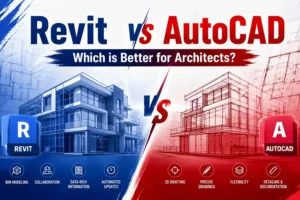
Revit vs AutoCAD: Which is Better for Architects?